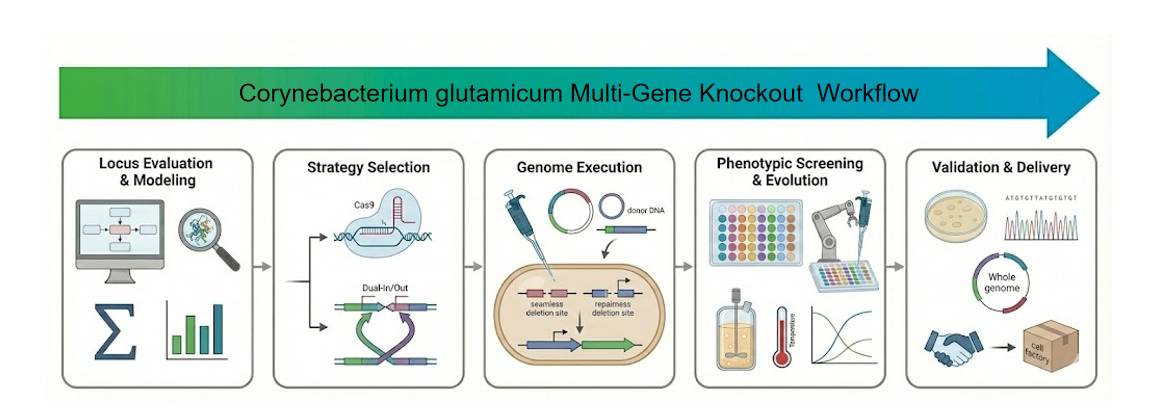
Application Study 1: Systematic Evolution for High-Temperature Tolerance
Industrial fermentation generates significant heat, hindering strain performance. Utilizing a Dual-In/Out strategy, research has optimized a platform for rapid multiplex editing. By knocking out stress-response regulators and performing directed evolution, industrial strains have been successfully evolved to maintain metabolic activity at temperatures up to 55°C, overcoming the limitations of traditional screening.
(Reference: Lobanova et al., 2022)
Application Study 2: Substrate Redirection for High-Yield Shikimate Production
Redirecting carbon flux from growth to synthesis is critical. Using CRISPR/Cas9-assisted engineering on streamlined chassis (e.g., CR100), technical benchmarks achieved the simultaneous deletion of pts (sugar transport) and iolR (regulatory inhibitor) genes. This creates a metabolic state where the strain bypasses standard glucose utilization to focus entirely on high-efficiency synthesis of shikimate.
(Reference: Ou et al., 2025)
Application Study 3: High-Throughput Synthesis of Amino Acids
Maximizing amino acids like L-threonine requires the elimination of multiple competing branches. By constructing a CRISPR/Cas9-assisted genomic editing system, research has demonstrated the ability to rapidly knock out multiple genes encoding competitive enzymes. This high-throughput approach shuts down side-pathways, channeling resources into the target synthesis and establishing a model for industrial amino acid optimization.
(Reference: Liu et al., 2021)