Home / Services / Synthetic Biology Chassis Development / Fungal Chassis Engineering / Yeast Genome Editing & Metabolic Engineering Solutions / Saccharomyces cerevisiae Genome Editing & Metabolic Engineering Solutions

Saccharomyces cerevisiae Genome Editing & Metabolic Engineering Services

Empowering the Next Generation of Microbial Factories through Precision Genomics and Metabolic Flux Optimization. Saccharomyces cerevisiae is no longer just a tool for traditional fermentation; it has become the premier eukaryotic chassis for the global bio-economy. CD Biosynsis provides professional Saccharomyces cerevisiae Genome Editing & Metabolic Engineering Services, combining cutting-edge CRISPR/Cas9 and CRISPRi/a systems with Adaptive Laboratory Evolution (ALE). We help our clients overcome cellular toxicity, optimize carbon flux from renewable feedstocks, and construct high-performance strains for the production of flavors, fragrances, and high-value industrial chemicals.

Get a Technical Quote
Services Offered Integrated Workflow Application Studies Key Advantages FAQs

Comprehensive Services Offered

Our platform transforms S. cerevisiae into a highly efficient production host through systemic genomic rewiring and fine-tuned transcriptional control. We focus on bridging the gap between laboratory design and industrial-scale performance.

Service Tier Technical Strategy Primary Application Standard Deliverables
Tolerance Engineering Adaptive Laboratory Evolution (ALE) Toxic product synthesis (e.g., PEA) Robust strains + Growth kinetic data
High-Efficiency Editing CRISPR/Cas9 Scarless Integration Biorefinery pathway assembly Verified mutants + Sequencing reports
Dynamic Metabolic Tuning CRISPRi (Interference) & CRISPRa Flux redirection & bottleneck removal Regulation-ready strains + qPCR data
Pathway Optimization Synthetic Regulatory Elements High-titer synthesis of bio-chemicals High-yield chassis + Titer analysis

Our Specialized Capabilities

  • Adaptive Evolution Platforms: Engineering strains to thrive in harsh environments, specifically for products with high cellular toxicity like 2-Phenylethanol (PEA).
  • Multi-Gene Biorefinery Integration: Rewiring yeast to utilize diverse carbohydrates (e.g., xylose and glucose) for conversion into chemicals like 1,2-propanediol.
  • Precision Transcriptional Control: Utilizing CRISPRi/a to precisely dial up or down gene expression, ensuring optimal metabolic flow without inducing stress.

Integrated Workflow

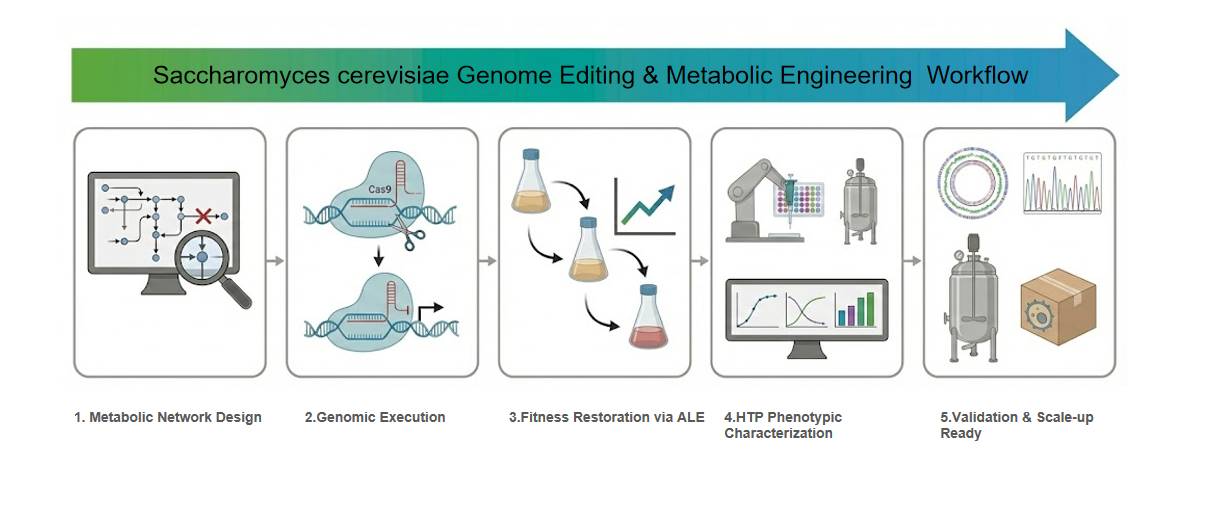
Saccharomyces cerevisiae genome editing and metabolic rewiring workflow

1. Metabolic Network Design

2. Genomic Execution

3. Fitness Restoration (ALE)

4. Scale-up Validation

Identifying rate-limiting steps and competitive pathways using in silico modeling to design the engineering strategy.

Formal project proposal and Mutual NDA signing.

Implementing CRISPR/Cas9 for deep knockouts or scarless integration, or CRISPRi/a for dynamic flux regulation.

Application of synthetic regulatory parts to optimize pathway throughput.

Subjecting strains to long-term evolutionary pressure to enhance product tolerance and restore growth rates.

High-throughput screening of variants under simulated industrial conditions.

Final genetic verification via WGS and delivery of optimized "Cell Factory" strains ready for industrial scale-up.

Comprehensive characterization of Titer, Yield, and Rate (TYR) in bioreactor environments.

Application Studies: Technical Benchmarks in S. cerevisiae Engineering

To deliver world-class results, our technical team continuously monitors and benchmarks our protocols against landmark research in the field.

PEA Tolerance (ALE) Biorefinery Chemicals CRISPRi/a Flux Control

Application Study 1: ALE for 2-Phenylethanol (PEA) Tolerance Engineering

PEA is a high-value fragrance ingredient, but its toxicity often limits production. By combining genome editing with ALE, benchmarks have successfully developed strains thriving under high PEA concentrations. These evolved strains maintain high metabolic activity, providing a stabilized platform for large-scale fragrance production.
(Reference: Frontiers in Microbiology, 2023)

Application Study 2: Biorefinery Conversion for High-Value Chemicals

A circular bio-economy requires yeast that can convert biorefinery sugars into raw materials. Utilizing CRISPR/Cas9, researchers rewired S. cerevisiae to ferment xylose and glucose into high-value chemicals like 1,2-propanediol. These strains exhibit high yields, demonstrating yeast as a versatile industrial biotransformation platform.
(Reference: Biotechnology Advances, 2021)

Application Study 3: Emerging CRISPRi/a Tools for Metabolic Flux Control

Industrial fermentation demands precise control to maximize output. Advanced CRISPRi/a systems provide a roadmap for the next generation of industrial yeast. These tools allow for the dynamic regulation of gene expression, ensuring carbon flow is redirected toward the target product at exactly the right time in the cycle.
(Reference: Frontiers in Bioengineering and Biotechnology, 2023)

Key Advantages

  • Scarless & Marker-free Editing: Ensures industrial strains meet safety regulations and remain stable over 50+ generations.
  • Overcoming Product Toxicity: Specialized ALE protocols designed to handle "difficult-to-produce" toxic chemicals like aromatics.
  • Dynamic Pathway Balancing: Advanced CRISPRi/a toolkits to ensure heterologous pathways do not overwhelm host metabolism.
  • Full IP Protection: All customized genomic designs and engineered strains are 100% owned by the client.

FAQs About S. cerevisiae Engineering

Ready to engineer your high-performance industrial yeast strain?

Contact Us

1. What is the advantage of ALE over rational design for tolerance engineering?

Rational design targets known genes, but ALE allows the yeast to find its own optimal solution to toxicity across its entire network. This results in far more robust strains for toxic chemicals like aromatics and solvents.

2. Can you perform edits in my proprietary industrial yeast strain?

Yes. We have extensive experience adapting our CRISPR toolkits to diversas industrial backgrounds. 我们在严格的保密协议(NDA)下工作,优化您的专属生产底盘。

3. Is the CRISPR/Cas9 machinery removed from the final production strain?

Absolutely. We use transient expression systems or specialized curing protocols to ensure no foreign Cas9 machinery remains, leaving you with a "clean" engineered product without foreign DNA footprints.

4. How do you handle the metabolic burden of multiple heterologous genes?

We use CRISPRi/a to fine-tune expression so enzymes are produced only when needed, and apply Adaptive Evolution (ALE) to select for cells that have successfully balanced their metabolic load for optimal growth.

5. What is the typical development cycle for a metabolic engineering project?

A standard comprehensive project—from initial design and CRISPR integration to ALE restoration and titer validation—typically takes 12 to 18 weeks.

Scientific References

  1. Construction of PEA-tolerant industrial S. cerevisiae via evolutionary engineering (2023).
  2. Metabolic engineering of S. cerevisiae for chemicals from biorefinery feedstocks (2021).
  3. New metabolic regulation technologies in S. cerevisiae expression systems (2023).