Home / Services / Synthetic Biology Platform / Design / Enzymatic Site-Specific PEGylation Services

Enzymatic Site-Specific PEGylation Services

CD Biosynsis offers cutting-edge Enzymatic Site-Specific PEGylation services, representing the next generation of precision bioconjugation. While chemical methods often rely on pH control or unique amino acid residues, enzymatic PEGylation leverages the absolute substrate specificity of enzymes to attach polyethylene glycol (PEG) polymers to highly defined locations. This biocatalytic approach ensures 100 percent regioselectivity and creates homogeneous conjugates that are virtually impossible to achieve through traditional chemical synthesis. By utilizing enzymes like Microbial Transglutaminase (mTGase), Glycosyltransferases, and Sortase A, we provide a "surgical" level of precision in protein modification.

Our enzymatic platform operates under extremely mild physiological conditions, preserving the delicate tertiary structure and biological activity of sensitive proteins and antibodies. This method is particularly powerful for proteins where N-terminal or Cysteine-specific modifications are not feasible due to structural constraints or functional interference. Whether you are engineering long-acting blood factors, optimizing antibody-drug conjugates, or developing novel fusion proteins, our enzymatic PEGylation services ensure a uniform product profile with simplified purification and superior batch-to-batch consistency.

Get a Quote
Technology Overview Key Biocatalysts Technical Workflow Core Advantages FAQs

Biocatalytic Precision for Next-Gen Biotherapeutics

Enzymatic site-specific PEGylation circumvents the heterogeneity issues of lysine-targeted chemistry by recognizing specific peptide motifs or glycan structures. For example, transglutaminases recognize specific glutamine residues within a flexible loop, while sortases recognize a five-amino acid "sorting signal." This high degree of recognition ensures that the PEG chain is attached only to the intended site, even in the presence of dozens of chemically similar residues. This structural "lock-and-key" mechanism is the gold standard for producing well-defined biopharmaceuticals with predictable pharmacokinetics.

Our platform integrates protein engineering with enzymatic modification. If a protein lacks a natural enzymatic recognition site, our team can introduce a small peptide "tag" (e.g., a GGG or LPXTG motif) via site-directed mutagenesis at a location that does not interfere with the protein's native function. This "tag-and-modify" strategy allows for the PEGylation of nearly any protein at an optimal, surface-exposed position. We use high-resolution LC-MS/MS to verify the site-occupancy and ensure that the enzymatic reaction has reached completion, delivering a conjugate with a defined drug-to-antibody ratio (DAR) or polymer-to-protein ratio.

Primary Enzymatic PEGylation Strategies

Transglutaminase (mTGase) GlycoPEGylation Sortase A Ligation

Transglutaminase-Mediated Conjugation

Mechanism

Catalyzes the formation of an isopeptide bond between the gamma-carboxamide group of a specific glutamine (Gln) and an amino-functionalized PEG reagent.

Specificity

Only targets Gln residues within specific flexible sequences, avoiding modification of buried or rigid Gln residues.

GlycoPEGylation Technology

Target

Utilizes sialyltransferases or other glycosyltransferases to attach PEG-sialic acid derivatives to the glycan chains of glycoproteins.

Advantage

Modifies the carbohydrate moiety rather than the protein backbone, effectively shielding the protein without altering its primary amino acid sequence.

Sortase A-Mediated Ligation

Mechanism

Recognizes the C-terminal LPXTG motif and cleaves the TG bond to form an intermediate that reacts with an oligoglycine-functionalized PEG.

Precision

Allows for absolute C-terminal specificity, making it ideal for the orientation-specific attachment of PEG polymers.

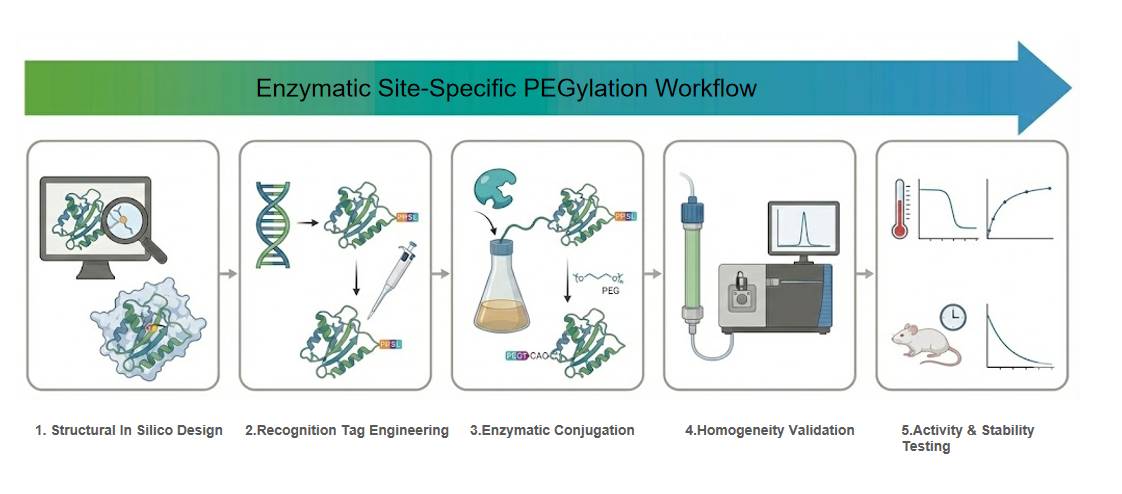
Technical Workflow for Enzymatic PEGylation

Our rigorous biocatalytic pipeline ensures maximum conversion and high-fidelity site-specific modification.

1. Motif Design & Engineering

2. Enzymatic Optimization

3. Purification & Enzyme Removal

4. Structural Proofing

Computational analysis to identify or introduce enzymatic recognition tags. Synthesis of specialized functionalized PEG reagents (e.g., PEG-amine or PEG-glycine).

Screening of enzyme-to-substrate ratios, temperature, and buffer conditions to achieve 90 percent plus conversion. Monitoring reaction progress via HPLC.

  • Primary Separation: Removal of the catalyst (enzyme) using affinity chromatography or Size Exclusion Chromatography (SEC).
  • Polishing: Isolation of the high-purity mono-conjugate via Ion Exchange or HIC.

Confirming site-occupancy via LC-MS/MS peptide mapping. Verification of purity via SDS-PAGE and analytical SEC. Biological potency validation to ensure the "surgical" modification has preserved efficacy.

Why Choose Enzymatic Site-Specific PEGylation?

Absolute Regioselectivity

Enzymes target a specific site with 100 percent accuracy, eliminating positional isomers and simplifying analytical characterization.

Ultra-Mild Conditions

Reactions occur at neutral pH and room temperature, making this the ideal method for fragile proteins prone to denaturation or aggregation.

Simplified Regulatory Path

A homogeneous product with a defined attachment point and 1:1 stoichiometry facilitates smoother IND and NDA regulatory filings.

Versatile "Tag" Options

Our ability to engineer enzymatically active "handles" onto nearly any protein surface provides unlimited design flexibility for PEG placement.

Frequently Asked Questions

Technical insights for your enzymatic PEGylation project.

Contact Us

1. How does enzymatic PEGylation compare to chemical N-terminal modification?

While N-terminal chemistry is specific, it is limited to the start of the sequence. Enzymatic modification can be performed anywhere on the protein surface where a recognition motif can be placed, providing much greater architectural control.

2. Does the enzyme remain in the final product?

No. We employ high-efficiency purification steps, such as His-tag removal of the enzyme or size-based chromatography, to ensure the final conjugate is enzyme-free and pure.

3. Is it necessary to add a peptide tag to my protein?

Not always. Some proteins have natural "reactive" glutamines or glycans that can be targeted. However, adding a small tag (3 to 5 amino acids) often provides better yields and more predictable results.

4. What structure of PEG is compatible with enzymatic modification?

We can use linear or branched PEGs, provided they have the correct enzymatic "handle" (e.g., a primary amine for transglutaminase or an oligoglycine for sortase).

5. Is GlycoPEGylation applicable to all proteins?

It is specific to glycoproteins. If your protein is non-glycosylated, we would recommend transglutaminase or sortase-based approaches instead.

6. How do you confirm the PEG is attached to the correct motif?

We perform peptide mapping using LC-MS/MS. By identifying the fragment containing the PEGylated motif and verifying the absence of modification on other residues, we confirm 100 percent site-specificity.

7. Can enzymatic PEGylation achieve 100 percent conversion?

While 100 percent is the goal, enzymatic reactions typically reach 85 to 95 percent conversion. We then use high-resolution chromatography to isolate the 100 percent pure conjugated fraction.

8. What is the typical lead time for an enzymatic project?

Due to the potential need for motif engineering and enzyme optimization, these projects typically take 8 to 12 weeks from initial design to purified delivery.

Would you like to discuss which enzymatic strategy—Transglutaminase, Sortase, or Glyco-targeting—is best suited for the structural requirements of your protein?

0

There is no product in your cart.