Home / Services / Synthetic Biology Platform / Design / N-terminal Specific PEGylation Services

N-terminal Specific PEGylation Services

CD Biosynsis provides a premier platform for N-terminal Specific PEGylation, a sophisticated site-specific conjugation strategy designed to enhance the therapeutic index of proteins and peptides. Unlike conventional random PEGylation which targets multiple lysine amino residues and results in highly heterogeneous mixtures, N-terminal targeting exploits the unique pKa properties of the alpha-amino group. By precisely attaching a single polyethylene glycol (PEG) chain to the N-terminus, we generate homogeneous conjugates that maintain structural integrity, exhibit predictable pharmacokinetics, and meet the stringent regulatory requirements for modern biopharmaceuticals.

Our technical team utilizes high-purity PEG-aldehyde reagents and a meticulously controlled pH environment, typically between 5.0 and 6.0, to achieve site-selectivity exceeding 95 percent. This approach ensures that the lysine side chains remain protonated and non-reactive during the coupling process. Whether you are working with fragile cytokines, growth factors, or complex enzymes, our end-to-end service covers everything from initial feasibility assessment and reagent screening to high-resolution characterization of the final purified conjugate, ensuring your molecule retains maximal bioactivity while gaining superior stability.

Get a Quote
Technology Overview Conjugation Chemistry Technical Workflow Core Advantages FAQs

Precision Through pKa Differentiation

The chemical foundation of N-terminal specificity lies in the fundamental acidity difference between amino groups. The N-terminal alpha-amino group typically possesses a pKa of approximately 7.6 to 8.0, whereas the epsilon-amino groups of lysine residues have a pKa of 10.0 to 10.5. By performing the reaction in a slightly acidic buffer, the N-terminal group remains significantly deprotonated and nucleophilic, while the lysine residues are safely masked by protonation.

This positional control is critical for maintaining the protein native conformation. Since the N-terminus is often located on the surface and distal to the active site or receptor-binding domain, PEGylation at this site rarely interferes with the protein biological function. Our platform integrates high-resolution liquid chromatography-tandem mass spectrometry (LC-MS/MS) and peptide mapping to confirm 100 percent positional fidelity, eliminating the positional isomers that plague traditional conjugation methods and complicate downstream regulatory filings.

Advanced N-terminal Coupling Strategies

Reductive Alkylation Site-Specific Acylation N-terminal Transamination

Reductive Alkylation via PEG-Aldehyde

Chemical Mechanism

In a pH 5.0 to 6.0 buffer, the PEG-aldehyde reacts with the N-terminus to form a Schiff base, which is then reduced by sodium cyanoborohydride to form a stable secondary amine bond.

Charge Preservation

Unlike acylation, this method maintains the positive charge of the N-terminal amino group, which is often vital for protein solubility and isoelectric point stability.

Precision pH-Controlled Acylation

PEG-NHS Esters

Utilizing N-hydroxysuccinimide (NHS) active esters under highly controlled kinetic conditions. While more reactive than aldehydes, acylation creates a permanent amide bond.

Peptide Mimicry

This method effectively mimics a natural peptide bond, making it suitable for proteins that require extreme chemical stability in serum environments.

Enzymatic Biomimetic Transamination

Ketone handle

Using reagents like pyridoxal-5-phosphate to convert the N-terminal amino group into a reactive ketone or aldehyde handle.

Oxime Ligation

The modified handle is reacted with an aminooxy-PEG to form an oxime linkage, providing an orthoganol chemistry route for proteins with sensitive lysine residues.

Technical Workflow: From Analysis to Delivery

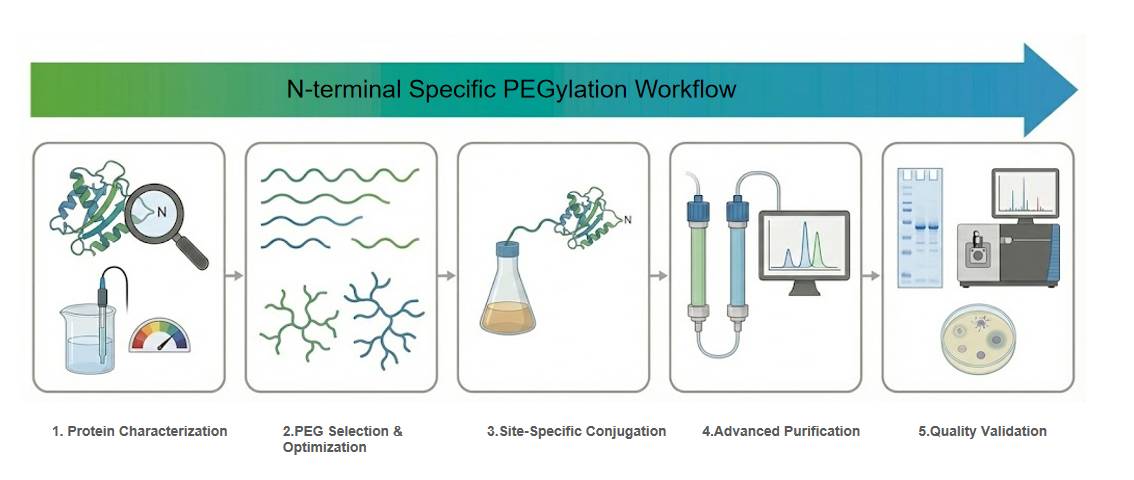
We apply a rigorous Design-Build-Test pipeline to ensure every PEG-conjugate meets the highest purity and bioactivity standards.

1. Computational Feasibility

2. Reaction Optimization

3. Advanced Purification

4. Structural Validation

Assessment of N-terminal accessibility using 3D structural modeling. Verification of the absence of N-terminal modifications and prediction of the optimal reaction pH based on the local environment.

Small-scale screening of PEG molecular weights and architectures like linear, branched, or Y-shape. Optimization of molar ratios and reducing agent concentrations to maximize yield.

  • Cation Exchange Chromatography: Separation of mono-PEGylated species from unreacted protein and multi-PEGylated isomers.
  • Size Exclusion Chromatography: Removal of high-molecular-weight aggregates and residual PEG reagents.

Confirming purity via SDS-PAGE and SEC-HPLC. Site-specific confirmation via enzymatic digestion followed by LC-MS/MS peptide mapping. Bioactivity assay to ensure therapeutic potency is maintained.

Why CD Biosynsis for N-terminal PEGylation?

Unmatched Homogeneity

Eliminate positional isomers and batch-to-batch variability, providing a single, well-defined molecular entity for regulatory filings.

Activity Preservation

N-terminal sites are typically distal to active pockets, minimizing steric hindrance and ensuring the protein native function is preserved.

State-of-the-Art Analysis

Access to high-resolution orbitrap mass spectrometry and automated peptide mapping to prove site-specificity definitively.

Broad PEG Portfolio

Select from an extensive library of activated PEG derivatives with diverse lengths and branching to fine-tune your molecule half-life.

Frequently Asked Questions

Expert insights into N-terminal conjugation challenges.

Contact Us

1. Why is pH so critical in N-terminal specific PEGylation?

Specificity depends on the pKa difference between the N-terminal amine and lysine amines. At pH 5.5, the N-terminus is reactive while lysines are mostly protonated, creating a high reactivity window for the N-terminus.

2. Can this method be used for proteins expressed in mammalian cells?

Yes, but with caution. Many eukaryotic proteins are N-acetylated during post-translational modification. We perform a preliminary analysis to check for blocked N-termini before proceeding.

3. Does N-terminal PEGylation affect the isoelectric point?

Reductive alkylation using PEG-aldehyde preserves the positive charge of the amine, resulting in minimal change to the pI. Acylation neutralizes the charge, which may slightly shift the pI.

4. How do you remove unreacted PEG from the final conjugate?

We utilize ultrafiltration or diafiltration for initial removal, followed by Size Exclusion Chromatography or Ion Exchange Chromatography to ensure the final product is free of free polymer chains.

5. What reducing agents are used and do they affect disulfide bonds?

We primarily use sodium cyanoborohydride. At the acidic pH levels used for N-terminal targeting, this reagent specifically reduces the Schiff base without disrupting stable disulfide bridges in the protein backbone.

6. What is the typical reaction yield for N-terminal PEGylation?

Depending on the protein accessibility, we typically observe mono-PEGylation yields of 60 percent to 85 percent in crude reaction mixtures, which are subsequently purified to high levels.

7. Is it possible to perform N-terminal PEGylation on peptides?

Absolutely. N-terminal PEGylation is a standard method to protect peptides from enzymatic degradation, thereby significantly increasing their metabolic stability in vivo.

8. How do you verify the site-specificity of the PEG attachment?

We employ proteomics techniques where we digest the conjugate and use mass spectrometry to identify the N-terminal peptide fragment, which shows a characteristic mass shift while other fragments remain unchanged.

Do you need a structural accessibility report for your protein, or would you like to discuss the optimal PEG molecular weight for your specific half-life extension goals?

0

There is no product in your cart.