Home / Services / Synthetic Biology Platform / Design / Cysteine-Specific PEGylation Services

Cysteine-Specific PEGylation Services

CD Biosynsis provides professional Cysteine-Specific PEGylation services, offering a high-precision site-specific conjugation strategy for the development of therapeutic proteins, antibodies, and peptides. Cysteine-specific PEGylation is often preferred over random lysine modification because cysteine residues are relatively rare on protein surfaces, allowing for better control over the stoichiometry and location of the polyethylene glycol polymer. By targeting either natural free cysteines or genetically engineered cysteine residues through Thio-PEGylation, we produce homogeneous conjugates with predictable pharmacokinetics and preserved biological activity.

Our technical team utilizes a variety of sulfhydryl-reactive chemistries, including maleimide, haloacetyl, and vinyl sulfone derivatives, to achieve stable and efficient coupling. This site-specific approach is particularly advantageous for maintaining the potency of the protein, as the PEG chain can be positioned away from the active site or receptor-binding domains. Whether you are working on half-life extension for small proteins or the development of complex antibody-drug conjugates, our platform provides verified homogeneity and full structural characterization of the final PEGylated product.

Get a Quote
Technology Overview Conjugation Chemistry Technical Workflow Core Advantages FAQs

High-Precision Thiol-Targeted Conjugation

Cysteine-specific PEGylation relies on the high nucleophilicity of the thiolate anion at physiological pH levels. Compared to the abundant amino groups of lysine residues, the sulfhydryl group of cysteine offers a unique chemical handle for site-selective modification. In proteins where free cysteines are not naturally available, our protein engineering team can perform cysteine scanning mutagenesis to introduce a single cysteine residue at an optimal surface-exposed position, ensuring that the subsequent PEGylation does not interfere with the protein native fold or function.

Our platform excels in managing the redox environment required for successful cysteine conjugation. We provide specialized protocols for the mild reduction of masked or disulfide-bonded cysteines using reagents like TCEP or DTT, followed by rapid conjugation to prevent protein aggregation or misfolding. By utilizing high-resolution analytical tools such as mass spectrometry and Ellman assays, we confirm the exact number of PEG chains attached and the site-specific fidelity of the conjugation, providing a well-defined molecular entity for therapeutic development.

Cysteine-Reactive PEGylation Chemistries

Maleimide Chemistry Haloacetyl Methods Disulfide Bridging

Maleimide-Activated PEG

Reaction Mechanism

The most common method, utilizing Michael addition of the thiol to the maleimide ring at pH 6.5 to 7.5 to form a stable thioether bond.

Selectivity

Excellent selectivity for thiols over amines, roughly 1000-fold within the specified physiological pH range.

Haloacetyl and Iodoacetyl PEG

Mechanism

Nucleophilic substitution where the thiolate displaces a halogen atom, resulting in an extremely stable thioether linkage.

Stability

Provides a bond that is resistant to the retro-Michael reactions sometimes observed with maleimide conjugates in serum.

Reversible Disulfide Linkages

Exchange Reaction

Utilizing PEG-ortho-pyridyl disulfide to form a reversible disulfide bond with the protein cysteine.

Applications

Ideal for applications requiring intracellular release of the protein or when the PEG shield must be removed under reducing conditions.

Technical Workflow for Cysteine PEGylation

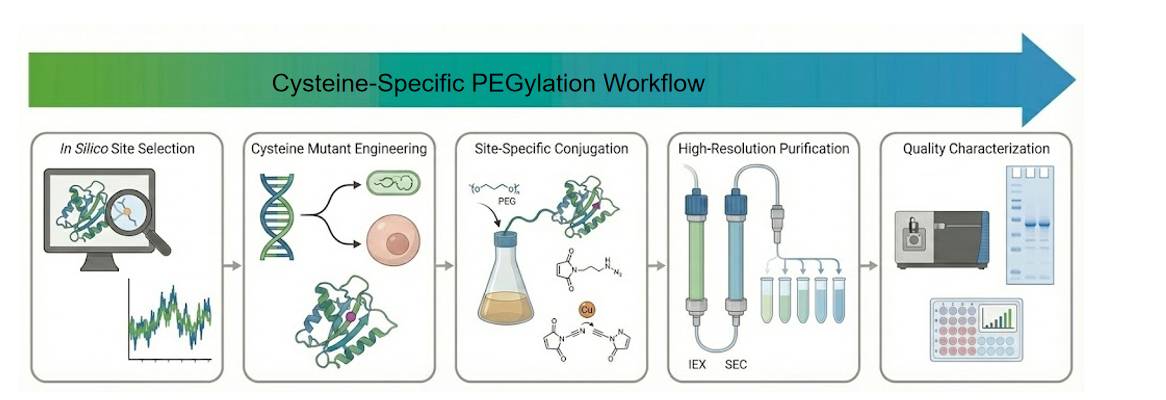
Our systematic pipeline ensures high-yield conjugation and comprehensive characterization of the site-specific product.

1. Structural Evaluation

2. Reduction and Activation

3. Purification

4. Analytical Characterization

Assessment of free thiol availability via Ellman assays. Computational modeling to identify optimal sites for cysteine engineering if a free thiol is not naturally present.

Controlled reduction of native disulfides or removal of cysteine capping. Optimization of pH and molar ratios of the cysteine-reactive PEG reagent.

  • Primary Separation: Removal of excess PEG and reducing agents via dialysis or tangential flow filtration.
  • High-Resolution Purification: Utilization of Cation Exchange or Hydrophobic Interaction Chromatography to isolate the mono-PEGylated species.

Purity confirmation via gel electrophoresis and HPLC. Molecular weight verification by MALDI-TOF or ESI mass spectrometry. Site-specific confirmation by peptide mapping and bioactivity validation.

Why Choose CD Biosynsis for Cysteine PEGylation?

Unmatched Homogeneity

Achieve a highly uniform product with precise control over the PEG-to-protein ratio, essential for clinical consistency and regulatory approval.

Preserved Bioactivity

By selecting distal cysteine sites, we ensure that the PEG polymer provides a shield against proteolysis without blocking active pockets or receptor binding.

Expert Engineering

Full support for Thio-modification through the introduction of de novo cysteine residues at strategic surface locations via site-directed mutagenesis.

Regulatory-Ready Data

Comprehensive analytical documentation confirming site-specificity and purity, suitable for IND and NDA filings.

Frequently Asked Questions

Technical insights for your cysteine PEGylation project.

Contact Us

1. What if my protein does not have a free cysteine residue?

We can utilize cysteine scanning mutagenesis to introduce a cysteine residue at a surface-exposed site. Our modeling team ensures the site is chosen to maximize PEGylation efficiency while minimizing the impact on biological function.

2. Are maleimide-thiol bonds stable in vivo?

While generally stable, thioether bonds formed by maleimides can undergo retro-Michael reactions in the blood. If extreme stability is required, we offer haloacetyl or vinyl sulfone chemistries as superior alternatives for long-term stability.

3. How do you prevent multi-PEGylation if multiple thiols are present?

If multiple free thiols are present, we optimize the stoichiometry and reaction time carefully. Additionally, we use high-resolution chromatography to separate mono-PEGylated variants from poly-PEGylated species.

4. Does PEGylation affect the isoelectric point of the protein?

Unlike lysine-specific PEGylation which consumes a positive charge, cysteine-specific thioether formation does not alter the charge of the protein, typically resulting in no change to the pI.

5. How is the PEGylation efficiency measured?

We use Ellman assays before and after the reaction to measure the decrease in free thiol concentration. Final efficiency and stoichiometry are confirmed by HPLC and mass spectrometry.

6. Can you perform PEGylation on antibody fragments like ScFv or Fab?

Yes, cysteine-specific modification is a standard method for PEGylating antibody fragments to increase their molecular weight above the renal clearance threshold while maintaining antigen binding.

7. What molecular weights of PEG are available?

We offer a wide range of cysteine-reactive PEGs, from 5kDa up to 40kDa, in both linear and branched architectures to meet specific half-life requirements.

8. What is the typical turnaround time for a PEGylation project?

A standard project from design to the delivery of the purified conjugate typically takes 6 to 10 weeks, depending on the complexity of the protein and the required purification steps.

Would you like to discuss the feasibility of introducing a cysteine residue into your protein sequence for site-specific half-life extension?

0

There is no product in your cart.