Application Study 1: High-Sensitivity qPCR for Food and Beverage Safety
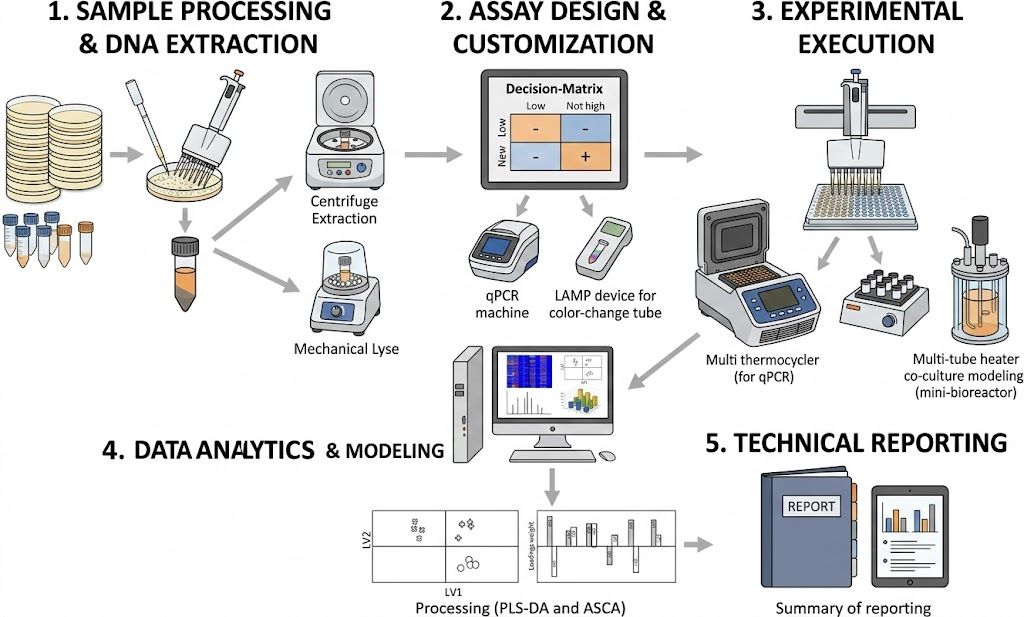
Ensuring raw material purity is vital for brewing. Technical benchmarks have established SYBR Green-based real-time PCR (qPCR) as a superior alternative to traditional culture. By utilizing species-specific primers, researchers successfully quantified A. niger loads in barley and malt within hours. This molecular approach provides higher sensitivity than morphology, enabling rapid decision-making in procurement.
(Reference: Comparison of qPCR and Culture Technique, 2022)
Application Study 2: Rapid Isothermal Detection (LAMP) for Field Diagnostics
In resource-limited environments, speed and simplicity are paramount. Advanced diagnostic projects have developed LAMP (Loop-mediated Isothermal Amplification) assays for rapid detection of A. niger. Requiring only a simple heat block, results are obtained within 30–60 minutes, providing a quantitative solution for farm-side testing and immediate infection control.
(Reference: Rapid and quantitative detection using LAMP, 2024)
Application Study 3: High-Throughput Screening for Industrial Sourcing
Large-scale operations require simultaneous screening of multiple contaminants. Technical platforms have integrated high-throughput real-time PCR to screen bulk shipments of grain. This approach allows brewing and food processing companies to simultaneously quantify A. niger and other fungi, helping enterprises evaluate raw material risks and establish data-driven quality standards.
(Reference: Screening of Mycotoxigenic Fungi, 2022)
Application Study 4: Modeling Biocontrol Potential for Sustainable Agriculture
A. niger possesses significant potential as a biological control agent against soil-borne pathogens. Modeling services have evaluated the antagonistic effects of A. niger against pathogens like Fusarium oxysporum. By utilizing dual-culture models and analyzing volatile metabolites, researchers established quantitative models of growth inhibition, providing a foundation for developing "green" biopesticides.
(Reference: Potential of Aspergillus niger for biocontrol, 2021)